iMoney · by hussh
iMoney is the investing app whose agents ask first — every trade, every time, in plain dollars, with a receipt for everything.
Hire small, careful agents to do the watching and the math. Nothing they propose happens until you say yes. And your children can learn right beside you, with an advisor your family chooses.


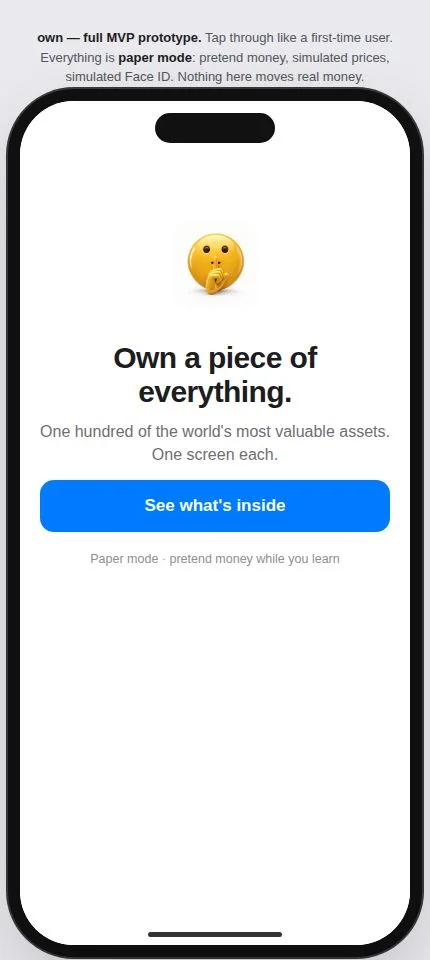
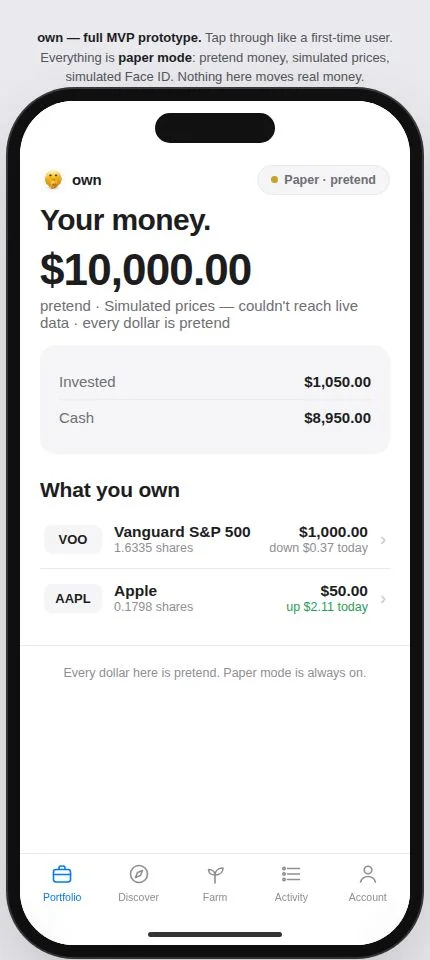
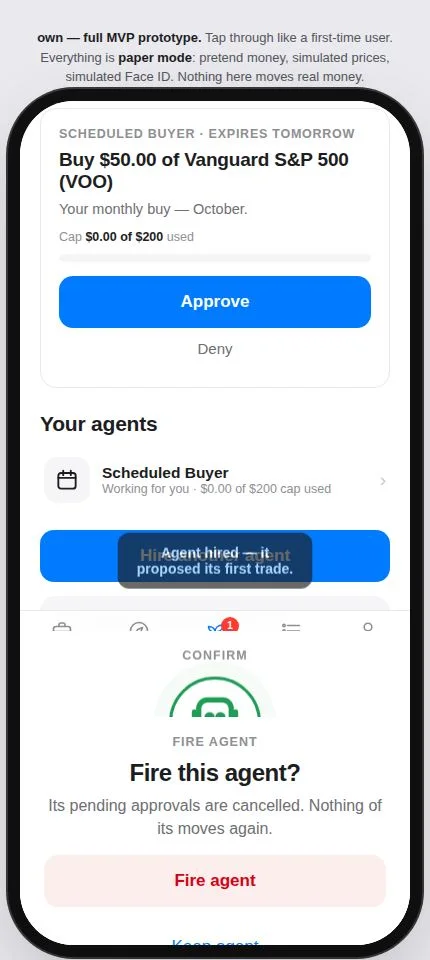
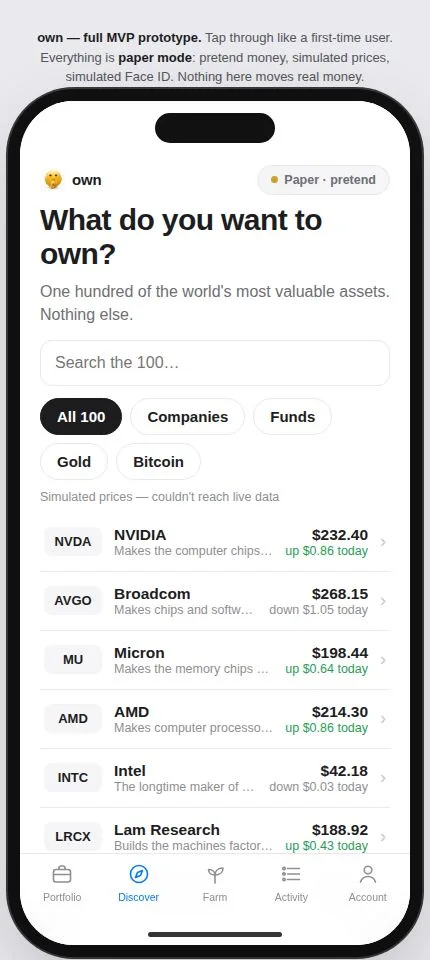
Real screens from the working iMoney prototype · Paper mode — no real money, anywhere, yet
Chapter One · Why iMoney Exists
For thirty years, the deal has been quiet and one-sided. The app is free because you are what it sells — your attention, your trades, your data, your habits, packaged for someone else. The buttons are bright where the platform earns and grey where you might stop and think. Confetti falls when you take a risk. Nothing in the design ever asks the only question that matters: is this good for the person holding the phone?
iMoney begins from the other end. Your money moves only when you say so — not when an algorithm decides, not when an agent gets confident, not ever. The agents in iMoney are tireless and careful, but they hold no power: they watch, they do the math, they bring you a proposal in plain dollars, and then they wait. You approve it or you deny it. Either way, there is a receipt.
And because money is a family subject long before it is a market subject, iMoney is where parents teach children to invest — real habits, real guidance, with a licensed advisor from the hussh network that the family itself chooses. Nobody's information is sold. Nobody is the product. The human is in control, always — that is not our slogan. It is the architecture.

— Manish Sainani, Founder & CEO, hussh
Chapter Two · The Product
Before iMoney lets you do anything, it makes you three promises — and it repeats them at every step, so you never have to wonder where you stand.
Check One
You say “$50 of Apple,” never a share count you have to compute. The app speaks in the money you actually have — the way people think about their own lives.
Check Two
No agent trades on its own. Every proposal arrives as a card — what, how much, why — and it expires if you ignore it. Your yes is the only trigger there is.
Check Three
You learn with paper money first — the full experience, zero risk. Real money enters only when you decide you are ready, and not one screen pretends otherwise.
Search companies, funds, gold and bitcoin. Each one gets a plain-language page — what it is, what it costs today, what changed — and one honest line about where the price came from. Selling only appears after you own something: buy first, in that order, on purpose.

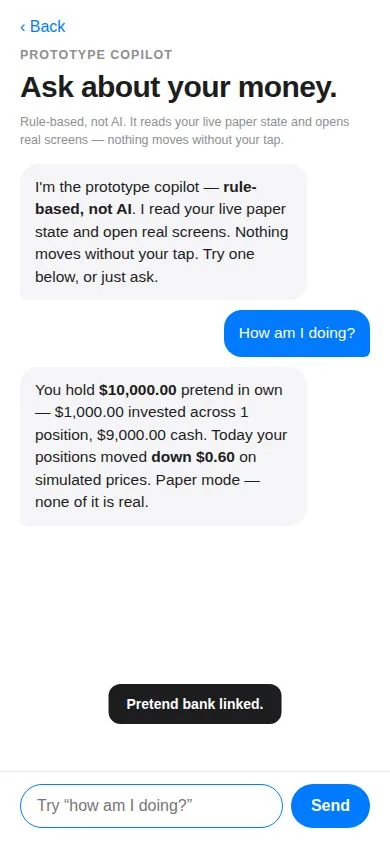
Ask how you are doing, or what you own, and the copilot answers from your actual portfolio. Ask it to start a purchase and it opens the real ticket — you still confirm every step. On screen, in plain sight, it tells you exactly what it is: an assistant, not an oracle.

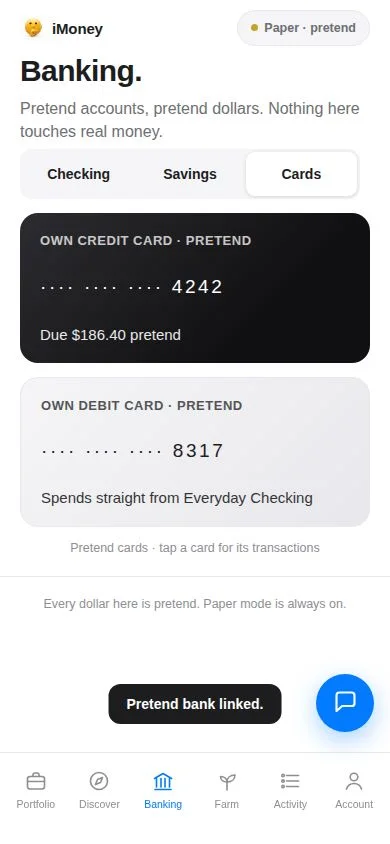
Checking, savings and cards in the same calm view as your investments. Move money, pay the card bill, see the due date behave like a fact instead of a trap. Every move lands in your activity — and in the audit trail.

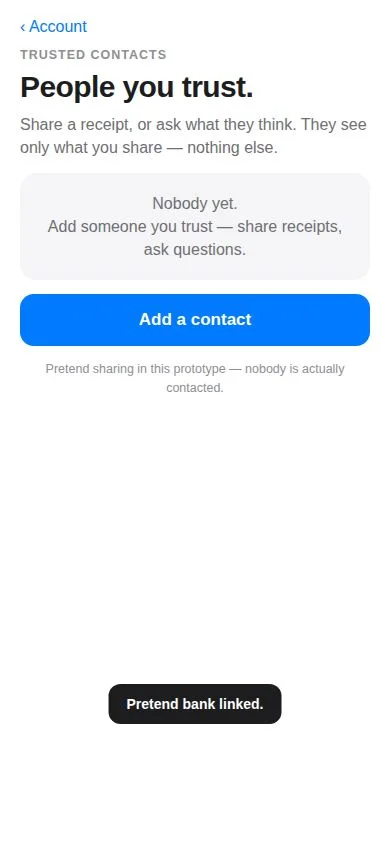
Add the people whose judgment you trust. Ask them about something before you buy it. Share a receipt with one tap. Investing stops being a solitary guess and becomes what it should have been all along — a conversation.

Chapter Three · The Farm
The farm is where iMoney's agents work. You hire each one for a single, narrow job, with a hard spending cap you set. They propose. You decide. That division of labor never blurs.
Agent Nº 1
“Put $50 a month into this fund — and check with me every time.”
Steady, boring, wealth-building consistency — without handing over the wheel. Each scheduled buy arrives as an approval card before it happens.
Agent Nº 2
“When something runs far enough, bring me the case for taking some off the table.”
Its proposals expire in one hour. Greed and hesitation both thrive on open-ended decisions; a deadline makes it a choice.
Agent Nº 3
“Watch the mix I chose. If it drifts, propose the one trade that fixes it.”
It speaks only when the drift is real — five points or more — and it proposes the single biggest corrective trade, never a flurry.

Nothing happens until this says yes
The rule underneath all of it: an agent's confidence is never a reason. Only your approval is. That is what “human in control” means when it is engineered, not advertised.
Chapter Four · Family Investing
Family investing is built into iMoney — not a separate app, not an afterthought. Parents fund a child's account, guide what happens in it, and bring in a teacher the whole family trusts.
Step One
You put money in — a birthday gift, an allowance with a purpose — and your child invests it in companies they actually know, in dollars they can picture. Small stakes, real decisions, real consequences, safely sized.
Step Two
You see everything, set the guardrails, and approve what needs approving. Your child builds the one skill no classroom teaches: judgment about their own money, practiced early, with you beside them.
Step Three
Attach the account to a registered investment adviser or CFP® professional on the hussh network — someone from your own community — who teaches your child how investing actually works, and helps your family plan together.

The circle they learn with
Chapter Five · Trust & Consent
iMoney runs on the Personal Consent Handshake Protocol — hussh's consent layer. Information moves only when you grant it, for the purpose you granted it, and the grant itself is recorded. Revoke it, and it stops.
You are the owner of everything hussh knows about you — from day zero. We never sell it. If your information is ever shared, it is because you chose to share it, with someone you chose, on terms you can see.
Every event in your account — every proposal, approval, trade and transfer — is written into a hash-chained audit trail. Tap verify and the app re-checks the whole chain in front of you. Export any receipt as a file, any time.
Where a price is simulated, the screen says so. Where a bank is pretend, it says pretend. Where the assistant is rule-based rather than AI, it says that too. A money app that labels its own limits is one you can build a life on.
Chapter Six · How It Works
Pick something you understand and say how much — “$50 of this fund.” Review it once, confirm, done.
Give each agent one narrow job and a hard cap. They start watching immediately — and proposing only.
Each proposal lands as a card with an expiry. Approve it, deny it, or let it lapse. Nothing happens in silence.
Your activity is a complete, verifiable story of your money — yours to check, share and export, forever.
Chapter Seven · The Launch
iMoney opens
December 27, 2026.
Between now and then, we finish the work in the open: the waitlist hears first, practices in paper mode, and walks in on day one already knowing their money's manners.
Automated checks green on the working prototype — real taps, in a real browser, including the rule that money is conserved across every move.
Checks on every screen — dollars not shares, approval first, paper before real — plus a hash-chained audit of everything that happens.
Real dollars moved, accounts opened, or pieces of your information sold. That stays zero until launch — and the last part stays zero forever.
Tell us where to write. Waitlist members get the first invitations, the paper-mode practice build, and the launch letter — before anyone else, in the order they joined.
Your place is saved. First invitations go out in join order, ahead of the December 27 launch. Welcome to money that asks first.
Chapter Eight · Asked Straight, Answered Straight
No — and this page won't pretend otherwise. iMoney is a pre-launch product. What exists today is a complete working prototype running in paper mode: simulated prices, pretend banks, no real money anywhere. It opens on December 27, 2026. The waitlist is how you get in first.
Not today. No account you open with us right now holds real securities, because there is nothing to open yet — the prototype trades paper, on purpose. We are building the launch product the licensed way, and before anyone is ever asked to fund an account, we will say plainly what is live, what it does, and through which regulated partners it works. If a money app won't tell you that, don't give it your money.
Pricing is not final, and we'd rather tell you that than decorate a guess. Final pricing is announced before launch, waitlist members hear it first, and nobody on the list is ever charged for joining it.
Independent registered investment advisers and CFP® professionals on the hussh network — licensed professionals, many from the communities our families already live in. You choose yours; you can detach them at any time. Family investing arrives with the launch product, and the advisor relationship is always yours, never assigned.
Never. Agents propose; only your approval executes. Proposals carry hard caps and they expire — an hour, a day — and silence is always read as no. Firing an agent cancels everything it has pending. This isn't a setting you can accidentally turn off. It's the design.
No. You own your information; hussh holds it under your consent, through the Personal Consent Handshake Protocol, and shares it only where you grant it. Selling the customer is the business model iMoney exists to replace.
The full iMoney experience — discovering, buying, hiring agents, approving proposals, reading receipts — run on simulated prices and paper money, so you can learn the product and your own habits with zero risk. The prototype labels it on every money screen. Practice first is Check Three, and it applies to us too: we'd rather prove the product in paper than promise it in prose.
The human in control — always,
over all machines.
That's the whole company, in one line. iMoney is simply where it meets your money.